Search This Blog

Saturday, August 23, 2014

FIA says FRIC no to trick suspensions in F1


Pastor Maldonado's Lotus at the 2014 Monaco Grand Prix


There are few fields in the world where you'll find engineers working as feverishly as they do in Formula One. With races sometimes won and lost by fractions of a second, every little bit counts, so each team retains legions of engineers, all dedicated to finding the tiniest performance edge... without running afoul of the ever-constricting regulations.

This season, one of the most controversial advances has been known as FRIC, and while it's been effectively sidelined for the last few races, reports from the motorsport press indicate that is has now officially been banned by the FIA.

So just what is FRIC? It stands for Front and Rear Inter-Connected suspension. Now, if you're thinking that independent suspensions are the most advanced form available, you're right, but F1 teams have been toying for years with ways to interlink the suspensions at each wheel. Why, you ask? For a number of reasons. For one, it allows for redistribution of suspension dive at the front or rear, which means that under hard braking or acceleration – when the car would either pitch back or forward – the car can be kept more stable. That, in turn, means not only are all four tires loaded evenly and optimally, but the team can also run a more aggressive aero package. It also means that the car can be set up with a softer suspension, allowing the driver to attack the curbs more aggressively, without sacrificing underbody aerodynamics.

Several teams had been running FRIC systems that move hydraulic fluid between the front and rear suspensions, but voluntarily agreed to cease using them for the last two races at Hockenheim and Budapest. Now, the FIA, having apparently deemed FRIC an unfair advantage in contravention of the sporting regulations, has reportedly banned the system altogether. So while those cars may not be running on an even keel any more, at least they'll all be on an even playing field.

Xcar takes a closer look at the electrifying Renovo Coupe


Renovo Shelby electric car


Xcar Films went to Pebble Beach and gave ex-Intel engineer and Renovo Motors CEO Christopher Heiser a platform to talk about his new electric supercar based on the Shelby Daytona Coupe. The relevant nuggets: 500 horsepower and 1,000 pound-feet of torque from direct-drive twin sequential axial flux motors powered by a lithium-ion battery, 0 to 60 in 3.4 seconds, top speed over 120 mph, 2,500 pounds, $529,000 to purchase.

While Heiser spends almost six minutes talking about the car and what it means to him, almost all of it is information we already know. When he gets to the bits that perk our ears, like when the mentions of advanced technology and upgraded parts, he skips the details. After four years of having to drive it at night to keep the secret, we don't even get to see more of what's inside, much less a daytime run with the Xcar chaps.

So we'll look forward to the next installment. In the meantime, this one's another beautiful entry in the Xcar catalog.

2015 Chevy Corvette Z06 priced at $78,995


Chevy Corvette Z06


Want to get your hands on the most powerful vehicle GM has ever made? It may be time to call your bank manager, financial adviser and whoever else helps you get your monetary ducks in a row, because Chevy has now revealed pricing information for the new 2015 Corvette Z06.

Pricing starts at $78,995 for the coupe and $83,995 for the convertible. Both those figures include destination, but don't include things like tax, title, license and optional equipment. And as we revealed when the order guide surfaced, there is some enticing optional equipment on offer.

An extra $2,995 will get you the Carbon Fiber Ground Effects package with enhanced aero. $7,995 will get you the Z07 Performance Package with Brembo carbon-ceramic brakes, upgraded tires and even more aggressive aero. There are three trim levels available and a host of other packages and options you can read all about in the press release below, from the Premium Package leather trim to the Performance Data Recorder.

No matter which way you set it up, though, you're getting a 6.2-liter supercharged V8 with 650 horsepower and just as much torque. And though the price of entry may seem high, it comes down to a downright steal compared to the six figures Chevy got for the previous ZR1 (whose place the new Z06 effectively takes) and which Dodge gets for a new Viper.

Volkswagen considering a four-door, four-seat XL1


Volkswagen XL1, front three-quarter view.

Posted Aug 22nd 2014 10:15AM


According to a report in Autocar, Volkswagen might have more in mind for the XL1 than mining it for advances to grace the next-generation Golf. Aiming to fight the Honda FCEV due for public consumption next year, we're told VW executives have put a four-door, four-seater version of the XL1 - it could be called XL2 - on the drawing board. The impetus is said to come from the top, with VW Group chairman Ferdinand Piëch intent on staying in the deep end of "super-efficent vehicles."

Autocar suspects the necessary changes could raise the weight of the car from 1,749 pounds to 2,068 pounds, which would make it four pounds less than the 2,072-pound Up! we drove a few years ago. Crucially, however, the mag thinks the extra capacity wouldn't change the two-seater's 310-mile-per-gallon rating, with tech tweaks and the aerodynamic benefit of a longer car offsetting the weight. Speculation is that the back seats would be staggered like the fronts in order to maintain the XL1's overall profile.

We recently heard about another XL1 variant that's gone off the radar entirely, the Ducati-engined XLR that we thought we'd see at the Geneva Motor Show and that was said to be going into production, so this one could go the same way. The biggest hurdle to making such an idea a reality, though, could be the price: the current XL1 costs 110,000 euros ($146,116). If VW really is going to compete with the Honda FCEV and the Toyota FCV - $70,000 in Japan - that might be where it wants to start.

2015 Chevy Corvette Z06 price and power compared against rivals


Ranking Z06 With Porsche, Ferrari, GT-R, Hellcat, Etc.

Posted Aug 22nd 2014 4:30PM


The 2015 Chevrolet Corvette Z06 is the most powerful production car ever from General Motors, and it's a technological landmark in the long lineage of Corvettes. It's also more affordable than you might think.

The 2015 Z06 starts at $78,995* – not chump change, but well below the price ranges of key competitors.
As was announced earlier today, the 2015 Z06 has a starting price of $78,995 for the coupe and $83,995 for the convertible, *including $995 in destination charges. That's not chump change, but it's well below the price ranges of several of its key competitors.

The Corvette has long been compared with the Porsche 911, but the Z06's 650 horsepower and 650 pound-feet of torque easily eclipses the most powerful 911, the Turbo S (560 hp, 516 lb-ft). The Z06 also costs less than half as much, as the Turbo S has a starting MSRP of $182,700, and then tacks on a $995-shipping charge.

A closer comparison – pricewise – would be the Porsche Cayman GTS, which comes in with an MSRP of $75,200 – that's $2,800 cheaper than the Vette. Thing is, it has 310 fewer hp.

The Audi R8 is a slightly more formidable competitor to the Z06 based on pure power. The V10 Plus has 550 hp, and its mid-engine configuration is a better layout for pure driving dynamics. But, its pricing starts at $173,500, not including a $1,250-destination charge. The base R8 with its 430-hp V8 begins at $115,000.


Then there's another long-running Corvette rival, the Dodge Viper SRT, and its 640-hp V10 engine. For 2014, the Viper costs $99,885, which is up $2,000 from 2013. Add in $1,995 shipping (your Viper does come in an enclosed trailer), and the total comes to $101,880. The price listed on the SRT website is $102,485, which includes the gas-guzzler tax, but not shipping. Regardless, it's about $22,000 more than the new Z06.

The all-wheel-drive Nissan GT-R, meanwhile, dials up 545 hp from a turbo V6 for $101,770, which rises to $103,365 with shipping.

The Z06 also grades out well in the world of exotics. The Ferrari FF produces 651 hp from its V12, which edges out the Z06 (barely), though the Ferrari only makes 504 lb-ft – all for a sticker of about $300,000 – though it does offer all-wheel drive.

Flipping the script on the Z06, the 2015 Dodge Challenger SRT Hellcat pumps out 707 horses for a price tag of $59,995 and a $995 destination charge brings the sticker to $60,990. That's more power for less money than the Corvette, but the Challenger is also a much larger car, and it's more of a muscle car than a sports car.

In this age of gaudy horsepower figures and prices, the Hellcat vs. Z06 is a fitting example of how modern sports cars are not all created equal. While the Hellcat can blow the doors off of the Vette with its power specs, the Z06 is assuredly a better track car. Porsche and Ferrari loyalists will naturally gravitate to and pay more for products from their brands, and no horsepower figure or "low-low" sticker price will change that. Plus, the sports-car segment is small enough in terms of sales so as to seemingly play by its own rules. No matter how much horsepower the Corvette has, it won't do much to erode GM's Corporate Average Fuel Economy standing.

While the Hellcat can blow the doors off of the Vette with its statistics, the Z06 is assuredly a better track car.
Still, the Z06 creates a seriously compelling value case for enthusiasts in search of power for a competitive price. Corvette spokesman Monte Doran reminded Autoblog that sharing parts and technology among Chevy vehicles has allowed the brand to keep prices of its high-end sports cars relatively low. The 2015 Chevy Corvette Z06 is the first Z06 to use a supercharged engine, the first to have a true convertible variant and the first to offer an eight-speed automatic transmission.

"Chevrolet has developed a successful model for sharing components with Corvette and other models in the portfolio," he said. "For example, the eight-speed transmission was designed for Z06, and will also be used in full-size trucks with the 6.2L; the carbon-ceramic brakes are shared between the Camaro Z/28 and Corvette Z06. This enables Chevrolet to offer stratospheric-levels of performance without stratospheric prices."

Dave Sullivan, manager of product analysis for AutoPacific, an automotive research firm, concurs:

"By sharing parts and components with higher-volume vehicles, GM can keep the price down on the Corvette," he said. "The Z06 could prove to be one of the memorable bargains of the century."

Sullivan expects the horsepower wars to continue, which is only good for enthusiasts.

"Look at the Ford GT a decade ago," he said. "It was about $150,000 for 550 HP and 0-60 in 3.7 seconds. For a little more than half that, you can get more power, better performance, and a car that the manufacturer is committed to building for many years to come. Inflation? What inflation?"

Thursday, July 24, 2014

Unplugged Performance sweetens the look of your Tesla Model S for around $6,000


Tesla Model S with Unplugged Performance Tuner Kit

Tesla electric vehicles are no strangers to the tuner set. Saleen is working on a modified Model S. Brabus once offered neon for your Roadster. And new we find a number of body panel upgrades for the Model S from Unplugged Performance.

Unplugged Performance has its offices right by the Tesla's Supercharger in Hawthorne, CA, and sales manager Mark Borushko told AutoblogGreen that Tesla employees often express their appreciation for what UP has done to change the look of the Model S. The upgrade parts are made in the US and were designed in-house by an ex-Ferrari guy, Borushko said.

What upgrades are there? There's the front spoiler and diffuser (starting at $995), the rear spoiler and diffuser ($1,550), trunk spoiler ($895), side skirts ($1,450) and the Complete Front Fascia System ($1,000). Those prices are all for the unpainted parts. Add a few hundred bucks to each to upgrade to matching paint colors or carbon fiber parts. Borushko said that in the year that Unplugged Performance has been around, they've sold about 30 kits – meaning one of everything – worldwide. There are people who just buy just the trunk spoiler, for example, he said, but about 90 percent of UP's customers opt for the full kit. Borushko said UP will have to see if there's interest in a kit for the Model X, but there likely will be.

Unplugged Performance is a part of Bulletproof Automotive, which offers upgrades for all sorts of vehicles. The Unplugged Performance phone number is the same as the one for Tesla Everything, so we're pretty sure someone over there is a big Model S fan.
News Source: Unplugged Performance via Teslarati

Lamborghini Aventador art car features every color of the rainbow


Lamborghini Aventador Roadster art car by Duaiv

With a catalog packed with shades of orange and yellow, the Lamborghini Aventador doesn't shy away from bright colors. But the stock palette still pales in comparison to this latest art car.

This technicolor Aventador Roadster was created by Franco-American artist and musician Duaiv, who previously applied his talents to Ferraris like the FF and 458 Spider. Lamborghini Miami, a division of Prestige Imports in North Beach, Florida, applied the evidently very successful artist's painting to a vinyl wrap and fitted to the Lambo along with a Novitec rear spoiler to create a one-of-a-kind supercar that is anything but a sleeper. You know, just in case an Aventador didn't already stand out enough.

2015 Acura NSX burns to the ground at the 'Ring


2015 Acura NSX fire

Assuming all goes to plan, automakers test their vehicles to the breaking point in the months and years leading up to that vehicle's actual release into the public. Which is good, because it's much better for a car to break in glorious fashion in the hands of the company that produces it than in the driveway of an owner who just spent their hard-earned cash to get it.

Such was the case with this production-guise Acura NSX prototype that we saw running around the Nürburgring just the other day. We can't be 100-percent certain, but the burned-out carcass is wearing the same number plate as the car that was spotted earlier, so it's likely the very same NSX. We have no idea what was the cause of the blaze that turned this Acura into the car-b-q you see pictured above, but our spy shooters on the ground in Germany say it was not involved in any collision, having caught on fire all on its own with engineers behind the wheel.

The good news is that nobody was hurt, though the car is quite clearly a complete loss. We're sure there's another ready to to test in the burned car's place... just as soon as the engineers at Honda figure out exactly what went wrong. Have a look at the smoldering aftermath up above.

Monday, July 21, 2014

2015 Ford Expedition


Blue Oval 'Burb-Fighter Boasts Turbocharged Boost
2015 Ford Expedition

Vital Stats

Engine:
Twin-Turbo 3.5L V6
Power:
365 HP / 420 LB-FT
Transmission:
6-Speed Auto
Base Price:
$40,000 (est)
As-Tested Price:
$58,000 (est)


While the tide of bigger-is-better SUVs has been in recession since, well, the recession, fullsize utes are still very much with us. Conservative creatures that have been loathe to evolve, fullsize SUVs nonetheless remain enduringly popular among large families, livery customers, and anyone with lots of friends, relatives, and toys to tug around. With respect to Toyota and Nissan, the only players that really matter in the segment are the new-for-2015 Chevrolet Tahoe/Suburban, the GMC Yukon/Yukon XL, and this truck: the Ford Expedition.
 
Unlike the General Motors utilities, the standard Expedition and the long-wheelbase Expedition EL are not all-new, but rather are heavily refreshed versions of the same basic truck Ford started selling way back in 2007. The front fascia is where most of the exterior update happens for 2015, with a new three-bar grille design, halogen projector headlamps, and new bumper design with available LED foglamps. Despite all the new bits, the facelift breaks exactly zero ground in terms of design; in fact, it already looks dated, and will only look older once the macho 2015 F-150 bows later this year. Even less has changed out back, where the tailgate gets a wide chrome band spanning the taillamps and a new chrome exhaust tip. Other exterior changes are generally limited to colors and an all-new wheel lineup that includes a gleaming set of six-spoke 22-inch polished wheels on high-end models.

Speaking of high-end models, a new Platinum trim is positioned above the cowboy-spec King Ranch model for 2015. Both the Platinum and King Ranch get their own color combos and exterior trim finishes (satin metal for the Platinum, chrome everywhere and ginormous badges for the King Ranch) and posh, leather-lined interiors with their own aesthetic. The Expedition family also now includes a price-leading XL model, as well as XLT and Limited grades.

That's nice and all, but we didn't fly to Appalachia to ogle new headlights and caress leather seats. The real draw was to see how the Expedition fares after making the switch from its outgoing V8 to turbocharged V6 power, the only way it will come henceforth. The change makes sense on paper, given that the turbo six – the same engine found in the F-150 EcoBoost – simply trounces the old V8 with 365 horsepower and 420 pound-feet of torque, compared to the outgoing 5.4's 310 hp and meager 365 lb-ft of torque. Notably, the EcoBoost V6 also outmuscles the 355 hp and 383 lb-ft of torque produced by the 5.3-liter base V8 in GM's portfolio, though it comes up shy of their forceful – and thirsty – optional 420-hp, 460 lb-ft 6.2-liter V8.

Saturday, July 12, 2014

Newest and Greatest from Porsche at Circuit of the Americas


Selling the Porsche 918 with leather, driver coaching and other special wishes


Also, it is a convertible. You’d think it wouldn’t be too hard to sell.

But it costs $865,000. And they're building 918 of them, unlike the more exclusive LaFerrari (499) and McLaren P1 (375). You can’t exactly slap a zero-percent financing sticker on it and put up TV ads for a 4th of July sale. Getting the Spyder in the hands of people who both can afford it and appreciate its majesty has been a multi-year process. Porsche has done everything it can, short of performing the Dance Of The Seven Veils, to seduce its potential buyers.

Every one of those 918 will be pressed to order and for those who signed up early, the wait is over. “Ralph Lauren got his car,” someone from Porsche told me. “Penske got his car. Seinfeld got his car.”

But there are still plenty available. In order to move their stock of The Greatest Car Ever Told, Porsche has been sending invitations out to people in its VIP program, potential customers who are either already high-end Porsche owners or owners of other supercars. This program is called “Porsche Exclusive,” though it used to be called “Special Wishes.” The name got changed, for obvious reasons. If wishes were Porsches, rich people would ride.

These are the kinds of customers who travel to Germany to consult on specs, or go to a dedicated Porsche design office in Beverly Hills. If they pay, they get whatever they want. One buyer is waiting until car number 666 rolls off the bespoke production line. I’m hoping its Ozzy Osbourne, though no names were revealed. (The top exhaust pipes would make terrific devil horns).

 Of late, exclusive customers have been getting access to track days at five locations around the country, which includes a walkaround of a pre-production Spyder, plugged into a wall unit like an ordinary Chevy Volt, some light catering, a couple of runs around the track in a quotidian 911 Turbo, and, finally, a few laps in the Spyder itself. The appointments are spaced out 45 minutes apart, to give the illusion of exclusivity. Everyone is allowed to bring one guest.

Porsche set up shop earlier this month for a couple of days at the Circuit Of The Americas in Austin. There, I met David Donohue, former champion of the GT2 class at the 24 Hours Of Le Mans. As of now, he’s also Porsche’s in-house 918 Spyder consultant, available at all times to any owner who needs his help and advice. “When these customers call,” he said, “I can’t say, ‘sorry, I’m on a race weekend.’”

Donohue has a long history working with Porsche, but he says he was drawn to the Spyder not only because of its performance, but also because of the technological advances it represents. The fact that it’s the fastest consumer car in existence, and also the most fuel-efficient hybrid, represents good news for car lovers who are feeling buffeted by the winds of climate change. “CAFE regulations and environmentalists are making us drive neutered cars,” Donohue told me. “And this is how Porsche responds.” It is sweet revenge.

I spent several hours at COTA, watching VIPs stagger around in shock after driving the Spyder, and did my own share of staggering after taking my laps. Shelby on a Popsicle stick, what a car. But that didn’t mean they were flying off the virtual lot. Most everyone else seemed exist in “I have to think about it” mode. They were wealthy, but not Jay Leno wealthy. One guy sat a table, looking through colored leather samples as desultorily as though he were picking out a new couch.

But I did meet one bona fide 918 Spyder owner. Dean Rogers, retired from the recording-studio business, had come down to Austin from Santa Fe, N.M., along with his garage manager, who helps maintain his dozen cars of various vintages. Rogers put down his deposit three and a half years ago, the day Porsche announced the Spyder on Dec. 3, 2010. “What they were claiming at the time seemed totally impossible,” he said. “It was a leap of faith. No one had ever done it before. But if you’re gonna have faith in a car company, have faith in Porsche.”

Rogers went to Stuttgart to see early models. The exhaust originally came out the side. (Now it comes out of the rear, through twin pipes.) It had tiny cameras instead of side mirrors. The steering wheel came off. It all seemed kind of weird.

“But I stayed focused on it,” he told me. “I was offered a P1 by McLaren, and I turned it down. I was offered a (Bugatti) Veyron, turned it down. The Spyder ended up being even cooler than the concept. I feel very fortunate to be able to drive this car, to even have the opportunity. It’s like a miracle.”

And that was before he’d taken his spin around the world’s most state-of-the-art racetrack. When he got out of the car, Rogers was almost quaking with excitement.

“The power was unbelievable,” he said. “I did the back straight in race mode. As far as traction and grip, it’s unlike anything else I’ve driven. It feels like I’m ten years in the future. At least ten. Everyone said Porsche couldn’t do it. But they did it. They really did it.”

Rogers said he plans to drive the Spyder in the Dust Bowl Rally, an exclusive drive of 30 cars, from Austin to Chicago in August. He’ll have some time to noodle around at home in it before then. Porsche was going to drop off his Spyder last week. His special wishes have come true.

Friday, July 11, 2014

Why Elon Musk is right about batteries being the future of automobiles


Recently, I visited the China International Battery Fair in Shenzhen. This is perhaps the largest battery show in the world, with over 980 exhibitors covering three-quarter of a million square feet. The three-day exhibition was followed by a three-day conference on battery technology and innovation drawing battery scientists from all over the world.

Almost everybody in the battery industry in China attends this show. There were lead acid batteries, NiCad batteries and all kinds of lithium-ion batteries. There were manufacturers of battery electrodes, separators and battery cases. Battery assembly equipment manufacturers were also present.

Most people think of China as a low-tech cheap labor market, but Chinese companies are now making the robots to produce batteries. Back in 2008, Chinese battery assembly equipment manufacturers were struggling to produce cylindrical cells. Today they have mastered the production of cut and stacked cells (which is where the future of lithium-ion technology is heading).

China's central government is investing huge resources into the battery industry to make China the world leader of battery technology.

One hundred years ago the engine was the key to manufacturing an automobile; for electric vehicles the battery is the key: that is where the power comes from. Batteries are the most expensive component in an electric vehicle, sometimes exceeding more than half the bill of materials cost. Tesla's Gigafactory will change the entire automobile industry and give Tesla an incredible competitive advantage, putting Tesla years ahead of all other automobile manufacturers. Tesla will turn its electric vehicle manufacturing volume into a battery cost advantage and make it very difficult for other automobile manufacturers to compete.

The Chinese government also understands the importance of batteries to the electric vehicle industry. The central government is investing huge resources into the battery industry to make China the world leader of battery technology. Close to 900 of the exhibitors at the CIBF were Chinese manufacturers.


China International Battery Fair 2014

The amazing thing about the CBIF is the breadth of the companies exhibiting at the show. Literally everything you need to manufacture batteries was there. The key to cutting battery costs is reducing capital investment and lowering component cost. Low-cost Chinese battery assembly equipment lowers the required capital investment. Chinese component manufacturers further lower costs.

So what happens to lithium-ion battery manufacturing in the US? Well, the US has a much larger market today with the Tesla Model S and the Chevrolet Volt. Volume drives down prices and robotics improve quality and level the playing field with respect to labor costs.

China has fostered an ideal environment to nurture start-up battery companies.

But China is undoubtedly the place to be for the small battery manufacturer. Battery manufacturing today is as much an art form as a science. The start-up company that invents a new recipe to increase power density and reduce cost could become a billion dollar company. With the abundance of battery component and material suppliers, China has fostered an ideal environment to nurture start-up battery companies.

China offers another competitive advantage. On an assembly line not all batteries will meet the manufacturer's specification. Low yields in a manufacturing process can be very costly. Battery manufacturers in China have a strong market to sell batteries which don't measure up to spec: electric bicycles. This market greatly reduces manufacturing risk and can be the difference between profitability and bankruptcy.

China Electric Bikes

Tesla has an advantage that other automobile manufacturers lack because they can justify investment in the Gigafactory to meet their present orders. They can build batteries in huge numbers that will attract component and material suppliers from all over the world. Tesla plans to manufacture a battery which has very high yields so it doesn't need a large market to sell batteries which are out of spec. And they are their own customer so they cut out the middleman while they cut their costs to the bone.

For the rest of the world, low cost batteries will come from China.

2014 Volkswagen Amarok Canyon


A Uniquely Teutonic Take On The Typical Truck
2014 Volkswagen Amarok Canyon

Vital Stats

Engine:
Turbodiesel 2.0L I4
Power:
178 HP / 310 LB-FT
Transmission:
6-Speed Manual
Base Price:
£20,000
As-Tested Price:
£37,841


There are those European automakers that compete in the North American market and those which don't. Volkswagen, for its part, may stand firmly in the former category, but there are still entire model lines that remain out of reach for American buyers: diminutive hatchbacks like the Up! and the Polo, of course, but also entire brands like Seat and Skoda which (unlike Audi, Porsche, Bentley, Bugatti and Lamborghini) aren't offered Stateside altogether. But there's another brand within the Volkswagen Group whose products don't, in Wolfsburg's estimation, warrant shipping to the United States – one that would be all too easy to forget. And that's Volkswagen Commercial Vehicles.

Saudi Arabia may institute higher fuel economy standards; keep 45-cent/gallon gas


ARAB OIL BOOM


When it comes to global oil production, Saudi Arabia is one of the absolute leaders, producing nearly 10 million barrels of crude every day. That means it can offer its citizens gas prices of about 45 cents per gallon. Despite this remarkably low price, though, the controversial, monarchical Middle Eastern country has just announced a series of reforms for the auto industry that will see American/European/Chinese-style fleet fuel efficiency standards come into effect.

According to Green Car Reports, the Kingdom's fleet standards are more lenient than those in the US and considerably easier to meet than Chinese or European standards. Fleets will need to return an average of 12 kilometers per liter (about 28.2 miles per gallon) by 2020. In the near term, though, vehicles will need to feature fuel economy labels as early as next month, and will need to meet more stringent fleet standards by late 2015 or early 2016. The push to increase fuel efficiency of Saudi cars is so intense that the country is even considering a program like Cash for Clunkers, in a bid to get older, less fuel efficient cars off the roads.

As for the motivation behind this sea change, it's a fairly simple one to break down – Saudi energy demand is increasing at a rate that the economy can't support, with a steady four-to-five-percent increase every year, according to Green Car Reports.

While we can get behind the reasoning and the new standards, what we don't understand is why fuel prices will remain at 45 cents per gallon. As GCR points out, this is not unlike the American model, where prices are intentionally kept lower while higher standards are mandated. But with such a ridiculously low fuel price, it seems odd that there isn't a proposal for at least a small price increase to help curb demand.
 
News Source: Green Car Reports
Image Credit: str / AP

Thursday, July 10, 2014

Pagani sends 40% of Huayras to US


Pagani Huayra


As big as the North American market is, it's hard for a small-scale European automaker to make it over here. The cost of pursuing certification both in Europe and in the United States is just too high for a small outfit to absorb. That's why Pagani, for example, never brought the Zonda to North America. But when it came to the newer Huayra, the Modenese automaker made EPA, CARB and NHTSA certification a priority - making Pagani the only automaker producing less than 100 vehicles per year to have achieved certification on both shores of the Atlantic.

And it's evidently glad it did, because the United States has become the single largest market for the Huayra. In fact, since the start of 2014, the United States has accounted for 40 percent of Huayra production. And that's not even accounting for other countries which adopt US standards as well instead of abiding by European certification. Earlier this year, the company established Pagani WorldWide as its US base of operations in San Francisco, orchestrating a network across North American with dealers in Connecticut, Miami, Dallas, Beverly Hills, San Francisco and Toronto.

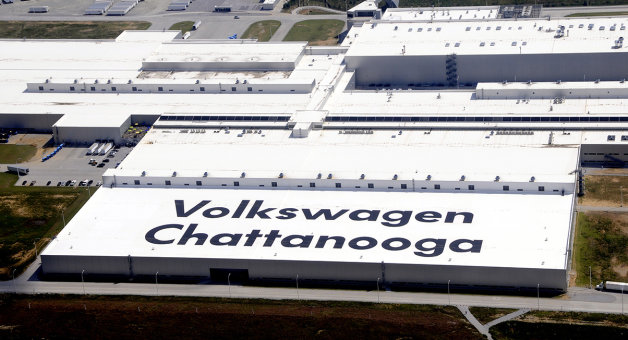
UAW forming local union for VW Chattanooga workers


Volkswagen Chattanooga Assembly


While the UAW was defeated in a February election at Volkswagen's Chattanooga factory, it wasn't enough to deter the union from future attempts at organizing the factory's labor force.

According to The Tennessean, the UAW is set to announce the formation of a union local for the plant's employees. Membership will be voluntary, and the union reports that VW won't formally recognize the local until a majority of the plant's workers join up.

"We will be announcing a local, and we would fully expect that Volkswagen would deal with this local union if it represents a substantial portion of its employees," the UAW's Region 8 director, Gary Casteel, told The Tennessean.

Apparently, the union has been considering this move since its 712-626 defeat in February, although the final decision was only made this week.

"The election was so close, we don't feel it's right to turn our backs on these workers," Casteel said.

The official announcement will be made at 4:00 PM today.
 
News Source: The Tennessean
Image Credit: Volkswagen

eBay Find Of The Day: 1946 Tucker Torpedo Prototype II hides a secret Riviera


1946 Tucker Torpedo Prototype Replica

The Tucker Torpedo is one of the great what-if stories of automotive history. Preston Tucker hoped to revolutionize the industry with a car unlike any other on the road at the time. However, due to a variety of problems, he only managed build 51 vehicles before closing shop. Over time, they have become highly sought-after; ​In 2012, one sold for $2.65 million at auction.

That brings us to this Tucker "replica" that you see above because it might be one of the ugliest monstrosities ever put together. However, we might extend some leniency to the creator, as the vehicle isn't actually trying to replicate the classic look of the 1948 Tucker 48 (a.k.a. 'Torpedo'). Instead, it is attempting to reproduce an earlier prototype from 1946 that actually features that weird, trident nose. According to the seller, his uncle built the car as a labor of love and supposedly used actual plans from Tucker as inspiration.

Underneath all of the crazy changes is a 1971 Buick Riviera powered by a 455-cubic-inch (7.5-liter) Buick V8. Some of the replica's odder modifications include the front fenders that turn with the wheels and the fin running down the back. All three headlights work, but the one in the middle is only for the high beams. Oddly, the small hinged sections on the roof are meant to open to avoid hitting your head when getting in or out. Maybe the seller's uncle was a very tall guy?

According to the eBay auction, the car does run but definitely needs some restoration, as well. It appears to be reasonably popular, though. As of this writing, it has 18 bids with a price of $7,300 with the reserve not yet met. Bidding ends on July 15.
 
News Source: eBay Motors

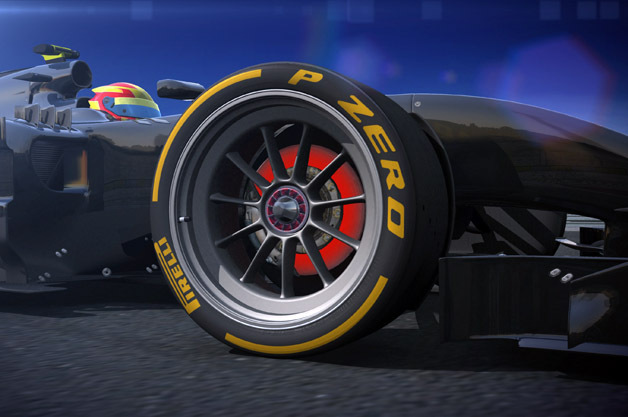
Pirelli: The new tyres looked stunning


Charles Pic drives the Lotus with new Pirelli 18 inch tyres

Pirelli’s new 18-inch concept tyres formed the centre of attention at Silverstone, with Lotus F1 Team Reserve Driver Charles Pic giving the new design its debut on Wednesday morning.
Pic headed out shortly after 9am in the current Lotus E22 equipped with the new 18-inch tyres and completed 14 laps of the Silverstone circuit. With the concept tyre designed principally to showcase aesthetics rather than performance, and a general-purpose compound, the lap times were not the focus.
Instead, the objective was to gauge reaction to the very different new design, which received the thumbs up from most observers.
Pirelli’s motorsport director Paul Hembery commented: “In our view, the new tyres looked stunning fitted to the Lotus, and the reaction has already been felt all over the world. These are just a prototype concept, but if the teams decided that they wanted us to proceed in this direction, we have the capability to carry on development in this area and come up with a production-ready version in a comparatively short space of time.”
“We’ve heard a lot of opinions already and we look forward to canvassing other opinions in the coming weeks and months. Even though performance wasn’t by any means priority here, the new tyres still behaved exactly in line with our expectations, so we’re clearly potentially at the beginning of a huge development curve, with the wheel and tyre size rules having remained unaltered for many years.”

Paul Hembery  with Lotus E22 on 18 inch Pirelli tyres
Paul Hembery with Lotus E22 on 18 inch Pirelli tyres

“These new tyres were clearly the focus of the test, but of course we managed to complete a lot of work for next year and the shorter term as well, with the two days of dedicated tyre testing from Ferrari, Marussia, Lotus and Red Bull as well. Having learned a lot from the previous tyre tests in Bahrain and Barcelona, we were now able to carry out a lot of more targeted work for 2015, on a fast and demanding circuit.”
The new tyres were designed and built in accordance with Pirelli’s premium strategy in Milan. The key technical advantage of an 18-inch tyre is a stiffer sidewall that helps maintain the structural rigidity of the tyre and also makes it easier for the tyre to maintain a constant pressure – as there is less actual air inside the tyre.
The new tyre is physically bigger, which makes it much more relevant to the Ultra High Performance tyres that are seen on the road, leading to greater technology transfer.
The new tyres tested today have the same width as the current 13-inch tyres (245mm at the front and 325mm at the rear) but a diameter that is bigger by 30mm.
The weight is approximately the same as the 13-inch tyre, because although the diameter is bigger, there is a smaller sidewall. The total weight, including the rim, is around 4 kilograms heavier. (Pirelli)

Wednesday, July 9, 2014

Students plan 'Ring record-breaker


Meet the IM01: a car to smash Bellof’s ‘Ring record and compete at Le Mans

This is a car with a Plan. It's called the IM01, and it's being developed by students from the Technical University of Eindhoven and the Fontys University of Applied Sciences for the ‘InMotion' motorsport firm.

The Plan? First, to smash Stefan Bellof's Nürburgring Nordschleife record of 6m 11.13s, and second, to compete at the 2017 Le Mans 24hrs as a ‘Garage 56' experimental car. No biggie, then.

So where most students' ambition is to make it into that 9am Critical Theory seminar for once while nursing a hangover from the seventh circle of hell, these plucky contenders are looking to build a hybrid prototype packed with racing tech for the most demanding race of them all. Maybe they don't have student union bars in Holland.
The IM01 will feature four electric motors - one on each wheel - along with a range-extender petrol engine, here taking the form of a rotary unit. Rotary units, as we know from the old Mazda RX-7 and RX-8, are cool.

Then there's that mad body with more downforce than you can shake an Adrian Newey at. We're told it'll run some form of blown diffuser - like those banned from F1 - along with a jet-fighter inspired cockpit for proper Maverick-esque japery.

These are just the first images, mind, so power and performance figures haven't been revealed. We understand the car will be ready by the end of next year, so we'll keep you updated.
Reckon it's got a chance of besting Bellof's 1983 time?

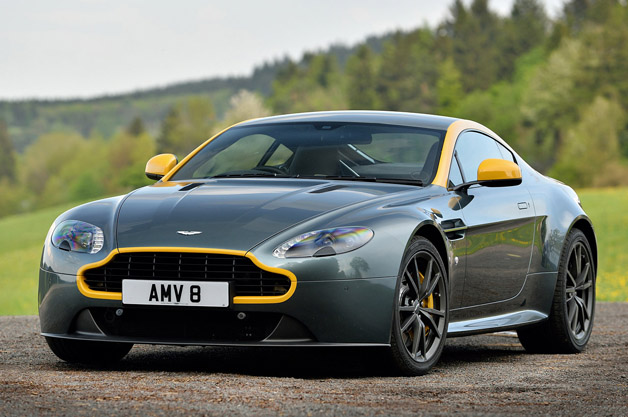
2015 Aston Martin V8 Vantage GT

Analog Warmth And Stunning Looks For Under $100k

2015 Aston Martin V8 Vantage GT

Vital Stats

Engine:
4.7L V8
Power:
430 HP / 361 LB-FT
Transmission:
6-Speed Manual
Base Price:
$102,725


Only one thing is going through my mind as I blast down the Autobahn at 170 miles per hour: If someone were to give me $100,000 today, I'd go buy a new Aston Martin V8 Vantage GT tomorrow.

I know there are a dozen other choices out there – cars that are more powerful, quicker around a road circuit and much less expensive, but you can keep your Corvette, your 911, your F-Type, your GT-R and your top-spec pony cars. My money would go towards this entry-level Brit with the metallic green paint and bright-yellow race-inspired accents.

Aston Martin has always crafted alluring – and expensive – automobiles. Yet this is the first time one of its offerings has come close to making sense to both the enthusiast's heart and to his or her accountant. It may sound absurd, but considering the GT's engineering, design, pedigree and hand-crafted execution, its $99,900 sticker price (plus $2,825 destination) makes it an absolute bargain.
Image Credit: Copyright 2014 Michael Harley / AOL, Aston Martin

VW issues NA Golf and GTI stop-sale over steering issue


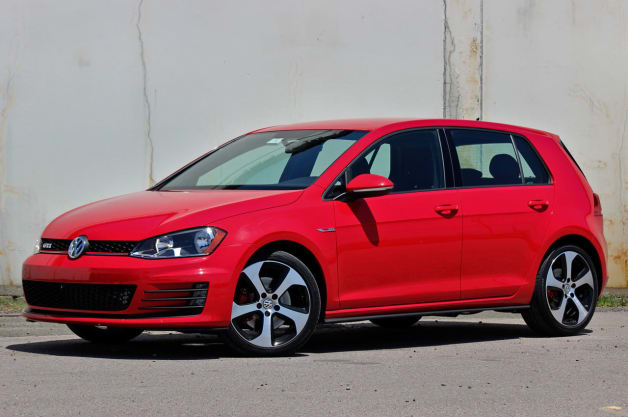
2015 Volkswagen GTI

Volkswagen is issuing a stop-sale and recall for the 2015 GTI and Golf because of a problem with the front stabilizer link fasteners. The stop-sale covers 705 vehicles at US dealers, and, according to Automotive News an additional 108 cars in Canada. Company spokesperson Jeannine Ginivan also told Autoblog that it's recalling 2,001 examples in the US and 446 in Canada that customers already own to repair the issue.

According to Automotive News, the fasteners were installed with too little torque during assembly and could work themselves loose. However, Volkswagen of America reports that there have been no fires, accidents or injuries caused by the problem. The fix involves dealers replacing the front stabilizer links on the affected vehicles, and obviously customers aren't being charged. Until repaired, the ones still on dealer lots can't be sold, though. Ginivan also confirms that most of the cars are GTIs because the Golf doesn't officially launch until August in the US.

Well hello, Carice, you Porsche-aping EV cutie


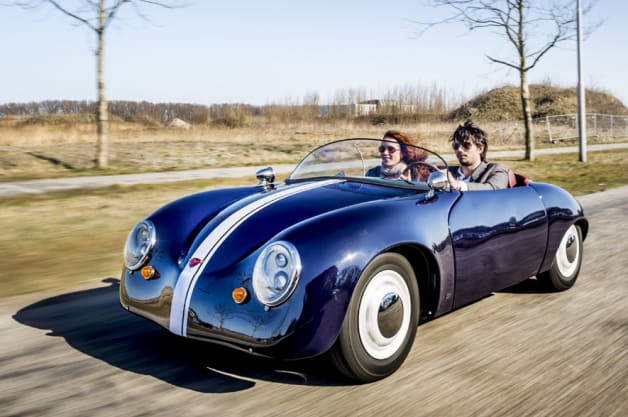
Carice MK1


Ah, the joy that comes open-air motoring with the in your hair and the roar of the exhaust behind you. Well, maybe not as much anymore. In recent years, vehicles like the Tesla Roadster have made the concept of the electric sports car palatable. Now, Dutch automaker Carice is following suit with a classically inspired EV speedster called the MK1.

The MK1 clearly wears its design inspiration on its sleeve. It would be difficult to look at this styling and not immediately see a Porsche 356 Speedster; It has the same upside-down bathtub shape with big round headlights and likely the tiniest taillights on a production car in years. The Carice is also clearly meant for fair weather motoring because there's no top, just a tonneau cover to protect the interior from the rain while it's sitting.

One thing that the Dutch company is definitely getting right is the weight. It claims that the MK1 weighs a dainty 772 pounds, including the battery pack. The low weight doesn't mean the MK1 is going to be lighting quick, though. It's being offered with a choice of three electric motors with 5 horsepower (for 16-year-old drivers in the Netherlands), 20 hp or 53 hp, and there are two sizes of battery pack. Buyers can also opt for a range-extending internal combustion engine. The 53-hp motor allows for a top speed of 62 miles per hour and a 124-mile range with the larger battery. Carice says its also willing to fit larger batteries or more power motors, at the buyer's expense, of course.

Carice plans to build an initial production run of 10 cars with prices starting at 22,000 euros, before Dutch taxes (about $30,000). The company hasn't released a press release about the MK1, but you can learn more about speedster on its website; it's in Dutch, though.
 
News Source: Carice Cars

Pirelli testing low-profile tires for 18-inch Formula One wheels


Pirelli's 18-inch F1 tire design


Detractors look at a modern Formula One car and wonder what relevance they could possibly have to the cars we drive. And they may have a point. Just look at the tires, for crying out loud: with sidewalls as tall as the wheels on which they're mounted, they look like they belong more on a cartoon car than a race car. But Pirelli is out to fix that.

The Italian rubber company has been the exclusive provider of F1 tires for the last four seasons since it replaced Bridgestone, but while it's developed its own compounds, the formula itself has remained largely the same. The regulations call for 13-inch wheels (plus or minus a few millimeters) with tires that can be no larger than 26 inches across (with a little extra for rain tires). And given that designers want as large a contact patch as possible, we're left with ridiculously tall sidewalls on artificially minuscule wheels that don't bear much resemblance to the tires we put on our own cars.

Pirelli's proposed solution is what you see pictured here. It wants to increase the wheel size to 18 inches and fit lower-profile tires to them in order to make them more relevant to road car tires, while also increasing sidewall rigidity to the betterment of handling – even if that would decrease the size of Pirelli's branding.

Of course, doing so would require a vastly different suspension setup if not an entire redesign, since the engineers take the sidewall compliance into account when designing the cars. But Pirelli is proposing the idea to the teams just the same, and will test the idea using a Lotus F1 car at the upcoming mid-season test at Silverstone. Watch the video animation below to see what Pirelli has in mind.

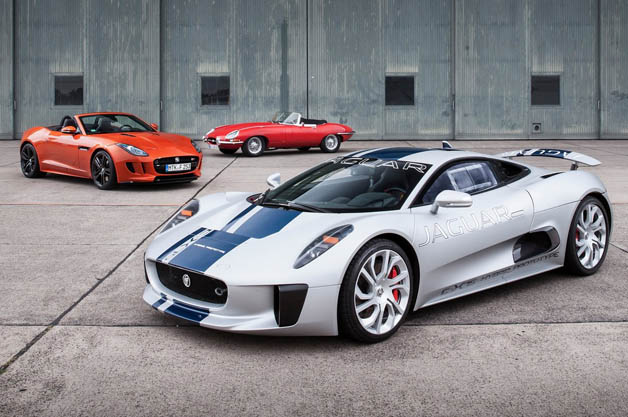
Jaguar working on lighter F-Type with C-X75's twin-charged engine?


Jaguar C-X75, F-type and E-type

Every automaker has its own agenda when it comes to concept cars. Some roll them out just to showcase where it's heading. Others create them to gauge public opinion for a potential production model. Still others only showcase a concept car to preview a model that's already well underway. Jaguar is just such a company.

In the last several years, Coventry has only produced a handful of concept cars, and each of them – the C-X16 that foreshadowed the F-Type, the C-X17 that previews the upcoming crossover and Project 7 that is now entering limited production – has led straight to the introduction of a new, commercially available model. Except for one: the C-X75.

The extreme lightweight supercar was set to succeed the XJ220 with a number of advanced technologies, but unfortunately Jaguar ended up pulling the plug to watch from the sidelines as McLaren, Ferrari and Porsche got all the attention for their new hybrid hypercars. But that doesn't mean that some of the technologies initially developed for the C-X75 won't find their way into other Jaguar products.

One project reportedly under consideration would be for Jaguar Land Rover's new Special Operations division to use the compact yet potent twin-charged engine in the F-Type. The 1.6-liter four-cylinder engine was designed as a replacement for the costly turbines in the original concept, but used both super- and turbochargers to deliver around 500 horsepower.

That's about as much power as the F-Type V8 S and a few steps short of the F-Type Coupe R, let alone the Project 7 speedster, but with half the cylinder count and less than a third the displacement, would weigh significantly less. That could mean extra space for a hybrid assist or enable spritelier dynamics all on its own, but if approved for production, we wouldn't expect it to come cheap: the engine was, after all, developed for a supercar. And if Jaguar were to make it, it could end up charging proper supercar prices for it, as well.
 
News Source: Auto Express

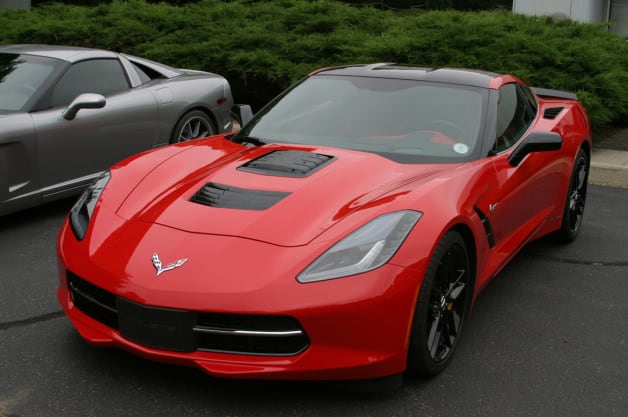
Corvette Stingray whipped up to 627 hp by Callaway


2014 Callaway Corvette

Callaway Corvette Dyno GraphIf you under promise and over deliver, you can never disappoint people, and apparently the tuning mavens at Callaway know that lesson well. When the company announced its latest tuned Corvette a few months ago, it said that it would have roughly 620 horsepower and at least 600 pound-feet of torque. That would have been impressive gains over the stock 'Vette by itself, but the new supercharged sports car has actually been rated at 627 hp and 610 lb-ft as its final specs. Job well done.

The key to the latest Callaway Corvette is its 6.2-liter supercharged V8 that gets a redesigned, patent-pending supercharger with a new intake manifold and an intercooler with three liquid-to-air cooling elements. The supercharger housing also protrudes through the hood to aid cooling even more.

According to the dyno (right), Callaway's Corvette reaches its peak 627 hp at 6,400 rpm, an additional 167 hp over the standard car and 23 hp less than the upcoming Z06. The Callaway's max 610 lb-ft comes on about the same time as the stock 'Vette at around 4,400 rpm. However, the supercharged engine has an impressive 145 lb-ft more than normal, but 40 lb-ft less than the Z06. The tuning company claims that it uses the same SAE-certified power correction method as Chevrolet to calculate the specs.

With the numbers official, the latest Callaway Corvette is now in production, and the company is already shipping them out to waiting customers. Prices start at $22,995, plus the cost of the donor car.

Monday, July 7, 2014

Elise Time Attack could be most extreme Lotus yet

Lotus Elise Time Attack


The Lotus Elise has given birth to some seriously fast and varied machinery. Aside from Lotus' own models like the Exige, 2-Eleven, 340R and Europa, electric vehicles like the Tesla Roadster, not to mention the never-released Dodge Circuit and Detroit Electric SP:01, are all based on the Elise's platform. As were/are the Melkus RS 2000, the Opel Speedster/Vauxhall VX220 and the Hennessey Venom GT. But this could be the most extreme use of the lightweight chassis yet.

This Series 1 Elise has been built by one performance-obsessed Brit with a single purpose: to compete in the UK's Time Attack championship. For those unfamiliar, Time Attack is something like a rally or a hillclimb event, only it takes place on a racing circuit. Each vehicle goes out on the track by itself and sets the best time it can, without needing to worry about other competitors until the finish line is crossed and it's the next racer's turn. That's what drove Lee to modify his Lotus so thoroughly, with more wings, diffusers, flaps and carbon fiber than a Boeing factory.


Saturday, July 5, 2014

British GP Qualifying: Rosberg snatches pole as Hamilton falters

Nico Rosberg on his way to pole at Silverstone
Nico Rosberg took his fourth pole position of the season in dramatic style at Silverstone , the German snatching top spot in the session in the final corners of his final lap in a rain-hit session that saw championship rival Lewis Hamilton finish sixth after abandoninghis final run.
Behind Rosberg, Sebastian Vettel claimed his first front row start since the Malaysian Grand Prix and Jenson Button grabbed a surprise third spot for McLaren at his and his team’s home race.
The session opened in relatively dry conditions and after banker laps on intermediate tyres, which left Hamilton in charge, ahead of Ricciardo. Throughout the opening laps, however, drivers were reporting that the track was dry enough for slick tyres.
Kobayashi was the first take on mediums but was soon back in the pits with a technical problem. The Japanese driver finished outside the 107 per cent cut-off, as did team-mate Marcus Ericsson.
Nico Rosberg celebrates in parc ferme
The switch to slick rubber sparked a chaotic final few minutes as the field desperately tried to exploit the improved conditions. In the scramble for lap tyime it was perhaps inevitable that some would be caught out, either by traffic or by the conditions, as rain began to fall again in the closing moments.
The surprise was that it was Ferrari and Williams in trouble. Fernando Alonso spun on his final flyer and missed the cut, finish in 19th place, one ahead of Raikkonen, who had to abandon his run due to yellow flags brought out by spins elsewhere. Williams’ Valtteri Bottas was 17th, ahead of team-mate Felipe Massa, both drivers having wild slides during their final laps.
Elsewhere FP3’s quickest man, Sebastian Vettel scraped through in 16th, behind team-mate Daniel Ricciardo. Jenson Button was fortunate, too, making it through to Q2 in 14th place despite having his best lap deleted for exceeding track limits.
Top three in parc ferme after qualifying
Q2 offered more uncertainty. The start of the segment was run on intermediate tyres following the shower at the end of Q1 but halfway through the track dried sufficiently for slicks to be used and again there was a scramble to put in a good lap.
This time though, no front-runners were caught out and eliminated were Romain Grosjean, Jules Bianchi and Max Chilton (who delivered an excellent performance for Marussia), Esteban Gutierrez, Pastor Maldonado and Adrian Sutil. It was a rough session for Sauber. Sutil did not take part in Q2 having spun out in Q1 and late in Q2 Gutierrez also spun off, the rear of his Sauber hitting the barriers hard.
Top spot in Q2 was occupied by Hamilton, the Briton recording a lap of 1:34.870, three tenths clear of team-mate Rosberg but a huge 1.4s ahead of third-placed Vettel.
The final session was as thrilling and surprising as the first. The timesheet after the first runs had a predictable look to it, with Hamilton on top ahead of Rosberg. But with five minutes to go the track conditions again became marginal. Button was told to pit and adopt a wait and see attitude.
Jenson Button will start his home race from third on the grid
When the time came to gamble or stay put however, some were once again caught out. Lewis Hamilton was one of them. The Briton went out but seemed to decide there was no time to be gained so abandoned his lap. Rosberg, by contrast, along with several others, felt differently.
Sebastian Vettel claimed provisional pole but Rosberg had yet to cross the line. When he did so the gap was huge, with the German having almost 1.4s over Vettel. Button was a surprise third for McLaren, with Nico Hulkenberg fourth for Force India. Kevin Magnussen completed a good day for McLaren by taking fifth place and Hamilton qualified sixth.
Seventh place went to Sergio Perez in the second Force India, ahead of Daniel Ricciardo in the second Red Bull. The final top 10 positions were filled by the Toro Rossos of Daniil Kvyat and Jean-Eric Vergne respectively.
Nico Rosberg celebrates his fourth pole position start of the season thus far
Nico Rosberg celebrates his fourth pole position of the season thus far
Qualifying quotes:
Nico Rosberg: “The tyres were still drying out so we lost time on the out lap. We sat in the garage and eventually came to the conclusion that we might as well go out out and have a look. Then it seemed like it was worth it because the last part of the lap was very dry. It was a great team effort.”
Sebastian vettel: “The start of Q3 we went out as one of last cars. We aborted the lap because it was impossible to set a decent time on the slick tyres. We sat in the garage waiting and eventually went out on dry tyres. We went out for one flying lap at the end – it was difficult to believe it was possible to find dry areas I think England is the only country where you get these sort of conditions but it worked out and it’s very positive for us to start from the front row.”
Jenson Button: “[Happy] like you could not believe” after qualifying third for his home race at Silverstone. It’s only third but for us after the last 18 months, we had no chance of getting this result. It’s nice to qualify so well in front of the home crowd.”
Nico Hulkenberg will start from fourth on the grid
Nico Hulkenberg: “I have never felt a circuit dry up that quickly. First, I felt it was undriveable and the next minute I felt it was completely dry. It was hard to judge what was going on out there. On the out lap, I thought ‘oh gosh this is not going to work, let’s not crash the car’. I was the first car to set a lap time in the final part, so I was still suffering from a few damp patches, but it’s a good result and I hope tomorrow is a good day.”
Lewis Hamilton: “I don’t know, I don’t have much of an answer. I just decided not to do the lap. I don’t have anything to say to you at the moment.”
Kimi Raikkonen: “It started to rain half-way through the lap. It got too wet. So something went wrong, it’s hard to tell right now.”
Fernando Alonso: “We are here in the TV compound, two Ferrari drivers and two Williams drivers, it’s something we did wrong compared to other teams. We need to study what happened. We will start at the back, we have some overtaking to do and we will try to enjoy. We have nothing to lose.”
Lewis Hamilton's body language summed up his afternoon
Lewis Hamilton’s body language summed up his afternoon
Niki Lauda: “It was tricky in the end, we were both well in the lead, then we had to make a decision on whether we go out again. They both pushed to go out. Lewis thought the circuit was slower so he stopped, Nico kept going. It was Lewis’ decision because he thought he cannot go quicker but Nico proved you can go quicker and he was proved right. This time Nico was outstanding again to grab pole under these difficult conditions.”
Christian Horner: “Seb did a great job to get second. We didn’t think the track was going to be better. It wasn’t Dan’s decision, he just did what he was told. As a team we made the wrong call, but there are other teams who made worse calls today.” (GP247-F1 Media)
 
British Grand Prix, Qualifying – Saturday, 5 July 2014
Pos No Driver Team Q1 Q2 Q3 Laps
1 6 Nico Rosberg Mercedes 1:40.380 1:35.179 1:35.766 21
2 1 Sebastian Vettel Red Bull Racing-Renault 1:45.086 1:36.410 1:37.386 19
3 22 Jenson Button McLaren-Mercedes 1:44.425 1:36.579 1:38.200 24
4 27 Nico Hulkenberg Force India-Mercedes 1:41.271 1:37.112 1:38.329 19
5 20 Kevin Magnussen McLaren-Mercedes 1:42.507 1:37.370 1:38.417 23
6 44 Lewis Hamilton Mercedes 1:41.058 1:34.870 1:39.232 19
7 11 Sergio Perez Force India-Mercedes 1:42.146 1:37.350 1:40.457 20
8 3 Daniel Ricciardo Red Bull Racing-Renault 1:44.710 1:38.166 1:40.606 18
9 26 Daniil Kvyat STR-Renault 1:41.032 1:36.813 1:40.707 21
10 25 Jean-Eric Vergne STR-Renault 1:43.040 1:37.800 1:40.855 21
11 8 Romain Grosjean Lotus-Renault 1:43.121 1:38.496
17
12 17 Jules Bianchi Marussia-Ferrari 1:41.169 1:38.709
17
13 4 Max Chilton Marussia-Ferrari 1:42.082 1:39.800
14
14 21 Esteban Gutierrez Sauber-Ferrari 1:43.285 1:40.912
16
15 13 Pastor Maldonado Lotus-Renault 1:43.892 1:44.018
15
16 99 Adrian Sutil Sauber-Ferrari 1:42.603 No time
8
17 77 Valtteri Bottas Williams-Mercedes 1:45.318

5
18 19 Felipe Massa Williams-Mercedes 1:45.695

5
19 14 Fernando Alonso Ferrari 1:45.935

6
20 7 Kimi Räikkönen Ferrari 1:46.684

7
21 9 Marcus Ericsson Caterham-Renault 1:49.421

7
22 10 Kamui Kobayashi Caterham-Renault 1:49.625

8


Q1 107% Time
1:47.406